
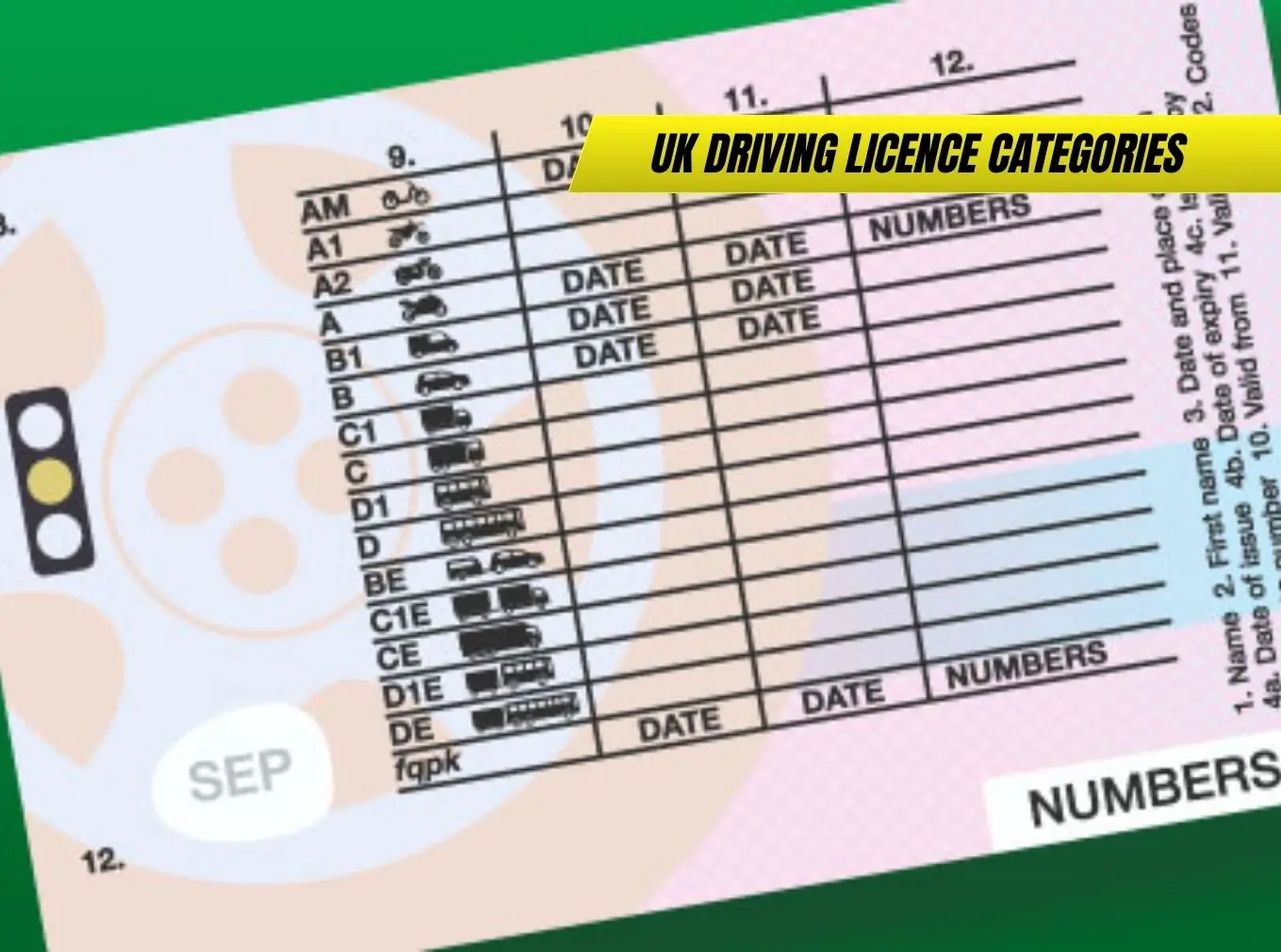
Complete guide to UK driving licence categories covering car, motorcycle, lorry and bus licences. Learn requirements, age limits and vehicle entitlements for all licence types in 2025.
Understanding UK driving licence categories can be complex, with multiple classifications covering everything from mopeds to articulated lorries. From my experience helping drivers navigate licence requirements, the system has evolved significantly to accommodate modern vehicle types whilst maintaining safety standards. Whether you’re a new driver seeking your first licence or a professional requiring commercial entitlements, this comprehensive guide covers all UK driving licence categories and their specific requirements.
Key Points: UK Driving Licence Categories 2025
- Category B covers standard cars and light vans up to 3,500kg
- Motorcycle categories range from AM (mopeds) to A (unlimited bikes)
- Commercial licences require additional medical checks and training
- Grandfather rights preserve older entitlements for existing licence holders
- Digital licences being trialled to replace physical counterparts
- Brexit changes affect international driving and licence exchange procedures
Understanding the UK Licence System
The UK operates a graduated licensing system that matches vehicle categories to driver experience and capability. Driver and Vehicle Standards Agency (DVSA) oversees all licensing procedures, ensuring consistent standards across England, Scotland, and Wales. Northern Ireland maintains a separate but compatible system through DVA Northern Ireland.
European harmonisation influences UK licence categories, maintaining compatibility with EU standards despite Brexit changes. This ensures UK drivers can continue operating commercially across Europe with appropriate documentation and medical certifications.
Licence codes on UK driving licences indicate specific entitlements and restrictions. Understanding these codes proves essential for compliance, insurance purposes, and employment requirements where specific categories are mandatory.
Moped and Light Vehicle Categories
Category AM – Mopeds and Light Quadricycles
Category AM represents the entry-level driving entitlement, accessible from age 15 (16 in Northern Ireland). This category covers mopeds up to 50cc with maximum speeds of 25mph, plus light quadricycles under 350kg.
No test required for AM if obtained alongside other categories, though standalone AM applications require compulsory basic training (CBT) and theory tests. Insurance requirements remain standard despite the limited vehicle specifications.
Age restrictions mean AM holders under 17 cannot carry passengers, whilst speed limitations may restrict route choices on faster roads where minimum speeds apply.
Category B1 – Motor Tricycles and Quadricycles
Category B1 covers motor tricycles over 15kW and quadricycles up to 400kg unladen weight. Available from age 17, this relatively uncommon category serves specialist vehicle operators and enthusiasts.
Testing requirements include both theory and practical examinations using appropriate vehicles. Medical standardsmatch Category B requirements, though specific training providers may be limited due to low demand.
Car and Light Commercial Vehicle Categories
Category B – Cars and Light Vans
Category B represents the most common UK driving entitlement, covering cars, vans up to 3,500kg, and small trucks within weight limits. Age requirement is 17, though accompanied learning can begin earlier with appropriate insurance and supervision.
Vehicle combinations include trailers up to 750kg, or heavier trailers provided the combined weight doesn’t exceed 3,500kg. This flexibility accommodates most domestic towing requirements without additional licensing.
Automatic restrictions apply when tests are taken in automatic vehicles, preventing manual transmission operation. Manual licences allow both transmission types, providing greater flexibility for vehicle choice and rental situations.
| Category B Entitlements | Specification Limits | Additional Notes |
|---|---|---|
| Maximum vehicle weight | 3,500kg | Including any load |
| Passenger capacity | 8 seats plus driver | Excluding driver’s seat |
| Trailer weight | 750kg or combined 3,500kg | Heavier trailers need BE |
| Minimum age | 17 years | 16 for disability allowance recipients |
Professional driving often requires Category B plus additional qualifications like Driver Certificate of Professional Competence (CPC) for passenger transport or goods vehicle operation exceeding domestic use.
Category BE – Car and Heavy Trailer Combinations
Category BE extends Category B to include heavy trailer combinations where trailers exceed 750kg and combined weights surpass 3,500kg but remain under 7,000kg total.
Practical testing focuses on reversing manoeuvres, coupling/uncoupling procedures, and safety checks specific to trailer operation. Theory requirements match Category B, as BE represents an extension rather than separate qualification.
Insurance implications often increase significantly for BE entitlements, particularly for young or inexperienced drivers. Commercial trailer use may require additional insurance coverage beyond standard comprehensive policies.
For drivers considering towing with electric vehicles, our guide to the best cheap electric SUVs explores EV towing capabilities and considerations.
Motorcycle Categories
Category A1 – Light Motorcycles
Category A1 permits motorcycles up to 125cc with power limits of 11kW and power-to-weight ratios not exceeding 0.1kW/kg. Available from age 17, this category provides economical transport with reasonable performance capabilities.
Testing requirements include theory, hazard perception, and practical modules comprising off-road manoeuvres and on-road assessment. Compulsory Basic Training (CBT) must be completed before practical testing.
Insurance costs for A1 motorcycles typically prove lower than larger machines, making this category attractive for young riders and urban commuters seeking economical transport solutions.
Category A2 – Medium Motorcycles
Category A2 covers motorcycles up to 35kW with power-to-weight limitations of 0.2kW/kg. Age requirement is 18, representing a natural progression from A1 or entry point for older riders seeking medium-capacity machines.
Direct access allows riders over 19 with two years’ A1 experience to take A2 tests without waiting periods. Progressive access encourages skill development through graduated exposure to increasing performance levels.
Restricted motorcycles derived from higher-power machines must demonstrate legitimate restriction methods meeting DVSA requirements. Insurance verification ensures restrictions are properly implemented and maintained.
Category A – Full Motorcycles
Category A provides unlimited motorcycle access regardless of power, weight, or performance specifications. Minimum age is 20 for progressive access from A2, or 24 for direct access without previous motorcycle experience.
Testing standards match A2 requirements but use unrestricted motorcycles demonstrating competence with full-power machines. Advanced training often proves beneficial given the significant performance increases available.
Tricycle entitlements over 15kW are included, plus motorcycle combinations with sidecars or trailers meeting specific construction requirements and weight limitations.
Commercial Vehicle Categories
Category C1 – Medium Goods Vehicles
Category C1 covers goods vehicles between 3,500kg and 7,500kg maximum authorised mass. Age requirement is 18, though Driver CPC qualification becomes mandatory for most commercial operation.
Medical examination by DVLA-approved doctors ensures fitness for commercial driving responsibilities. Enhanced medical standards exceed Category B requirements, reflecting increased vehicle size and professional duties.
Training courses typically last 5-7 days covering vehicle systems, load security, driving techniques, and legal responsibilities. Theory and practical tests both require higher pass standards than Category B examinations.
Category C – Large Goods Vehicles
Category C permits goods vehicles over 7,500kg with trailer combinations up to 750kg. Minimum age is 21, reduced to 18 for apprenticeships or Driver CPC holders meeting specific training requirements.
HGV training involves comprehensive courses covering vehicle inspection, load planning, route selection, and professional responsibilities. Test standards reflect the significant safety implications of operating large commercial vehicles.
Employment prospects in logistics, construction, and transport sectors often require Category C, making it valuable for career development despite higher training costs and medical requirements.
Category CE – Articulated Vehicles
Category CE extends Category C to include heavy trailers and semi-trailers regardless of weight. This represents the highest commercial driving qualification, enabling operation of maximum capacity road trains.
Additional training focuses on articulated vehicle handling, complex manoeuvring, and advanced load security. Test requirements include uncoupling/recoupling procedures and reversing articulated combinations.
Professional opportunities expand significantly with CE qualification, though ongoing CPC requirements and medical examinations maintain higher compliance burdens than lower categories.
Passenger Vehicle Categories
Category D1 – Minibuses
Category D1 covers vehicles with 9-16 passenger seats plus driver, commonly known as minibuses. Age requirement is 21, reflecting passenger safety responsibilities and professional driving standards.
PCV training includes passenger safety, route planning, emergency procedures, and customer service elements. Medical standards exceed goods vehicle requirements given direct passenger responsibility.
Common applications include school transport, community buses, and accessible transport services. Driver CPCbecomes mandatory for most commercial passenger operation exceeding voluntary community transport.
Category D – Full Passenger Vehicles
Category D permits buses and coaches regardless of passenger capacity. Minimum age is 24, reduced to 21 with accelerated training and Driver CPC qualification demonstrating enhanced competence.
Comprehensive training covers large vehicle dynamics, passenger management, route knowledge, and emergency evacuation procedures. Testing standards reflect the complex safety responsibilities involved in passenger transport.
Career opportunities in bus operation, coach touring, and school transport require Category D, though shift patterns and traffic conditions can prove demanding for some drivers.
Trailer and Combination Categories
Category E represents extensions to existing categories, permitting heavy trailer combinations beyond standard limits. Separate tests are required for BE, C1E, CE, D1E, and DE depending on the base category and intended vehicle combinations.
Testing focus emphasises coupling procedures, reversing manoeuvres, and combination handling rather than basic vehicle operation. Base category competence is assumed, with assessments targeting trailer-specific skills.
Insurance requirements often increase significantly for E category entitlements, particularly for commercial operations or high-value trailer combinations requiring specialist coverage.
Medical Requirements and Restrictions
Medical standards vary significantly between licence categories, with enhanced requirements for commercial and passenger transport licences. Group 1 standards apply to Categories A, AM, B, BE, and B1, whilst Group 2 standards govern commercial categories C, CE, D, DE, and their subcategories.
Periodic medical examinations ensure continued fitness, with renewal intervals decreasing as drivers age. Medical conditions that develop after licensing may require restriction codes or category limitations to maintain road safety.
Vision standards specify minimum acuity levels and visual field requirements that vary between categories. Diabetes management, cardiovascular conditions, and neurological disorders receive particular scrutiny for commercial licence holders.
Licence Renewals and Penalties
Renewal periods depend on licence categories and holder age. Standard licences require renewal every 10 years until age 70, then every 3 years. Commercial licences have shorter renewal cycles with annual medical examinations for older drivers.
Penalty points affect all licence categories equally, with 12 points resulting in disqualification. New drivers face enhanced penalties with 6-point revocation during the first two years requiring complete retesting.
For comprehensive information about penalty points and their implications, see our detailed guide to UK driving licence points.
❓ Frequently Asked Questions
What vehicles can I drive with a standard Category B licence?
Category B licences permit cars, vans, and small trucks up to 3,500kg maximum authorised mass with up to 8 passenger seats plus driver. You can also tow trailers up to 750kg, or heavier trailers provided the combined weight doesn’t exceed 3,500kg. Automatic restrictions apply if you took your test in an automatic vehicle, preventing manual transmission operation.
How do I upgrade from A1 to A2 motorcycle licence?
Progressive access allows A1 holders to take A2 practical tests after 2 years’ experience and reaching age 19. No theory test is required as A1 theory remains valid. Training with approved instructors is recommended, and you must take practical tests on an A2-specification motorcycle. The waiting period can be reduced through direct accesstraining programmes.
What medical requirements apply to commercial driving licences?
Commercial licences (Categories C, CE, D, DE) require Group 2 medical standards with examinations by DVLA-approved doctors. Enhanced vision standards, cardiovascular assessments, and diabetes monitoring apply. Medical certificates are valid for 1-5 years depending on age and health conditions. Periodic renewals ensure continued fitness throughout commercial driving careers.
Can I drive abroad with my UK licence after Brexit?
EU/EEA driving requires International Driving Permits for UK licence holders visiting post-Brexit. 1968 IDPcovers most European countries, whilst 1949 IDP serves specific destinations. Commercial operations may require additional driver attestations and CPC documentation. Permanent residence in EU countries typically requires licence exchange within specified timeframes.
What happens if I’m caught driving without the correct licence category?
Driving without proper entitlement constitutes driving without a licence, carrying £1,000 fines and 3-6 penalty points. Insurance may be invalidated, creating unlimited liability for accident costs. Vehicle seizure is possible, with recovery costs and storage fees adding to penalties. Repeat offences can result in court appearances and driving disqualification.
How long does it take to get commercial driving licences?
Category C training typically requires 5-7 days intensive courses plus medical examinations and theory/practical tests. Processing times for provisional entitlement average 2-3 weeks after medical approval. Driver CPC adds 35 hours initial qualification training. Total timescales from application to full qualification typically range 6-12 weeksdepending on test availability and training schedules.
Do I need different insurance for higher licence categories?
Commercial licences typically require business use insurance covering goods carriage or passenger transport. Higher risk categories like CE or D command significant premium increases. Professional indemnity and public liability coverage may be mandatory for certain operations. Fleet insurance often proves more cost-effective for businesses operating multiple commercial vehicles with appropriately licensed drivers.
Planning Your Licence Progression
Understanding UK driving licence categories enables strategic planning for career development, vehicle ownership, and mobility requirements. From my experience, progressive licensing through graduated categories often proves more cost-effective than direct access routes, whilst providing valuable experience development.
Training quality varies significantly between providers, making research and comparison essential for optimal outcomes. Government-approved training centres typically maintain higher standards, whilst intensive courses can reduce time requirements for motivated learners.
Medical fitness becomes increasingly important for higher licence categories, making early health assessmentvaluable for long-term career planning in commercial driving sectors.
The evolving vehicle landscape including electric commercial vehicles and autonomous driving technologies will likely influence future licence categories and training requirements. For insights into emerging vehicle technologies, explore our guide to best family SUVs covering modern vehicle capabilities and requirements.





